Tamsui Old Street
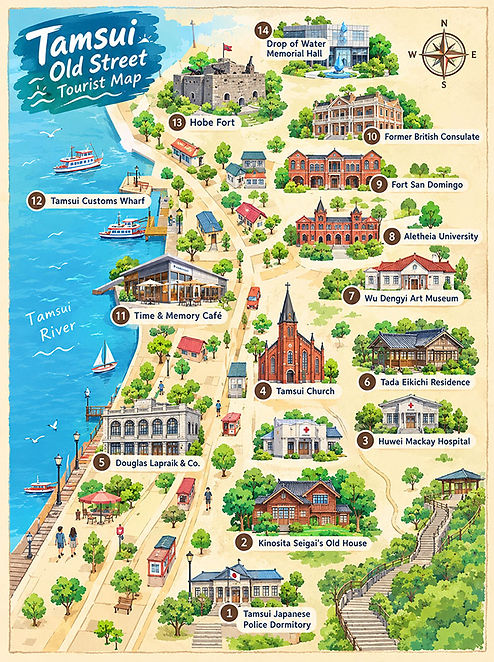
Tamsui is a town packed with history. Situated right where the Tamsui River meets the sea, it serves as the gateway to northern Taiwan. Back in 1858, it opened up as a trading port, making it the earliest developed port in northern Taiwan. Aside from a small flat area at the river mouth, most of the landscape is covered by the rolling hills of the Tatun Mountain range.
Today’s Tamsui District was originally called "Huweil," while "Tamsui" was a broader term used for the entire Tamsui River basin—and sometimes even all of northern Taiwan. There are two main theories behind the name "Huweil." One is that it’s a phonetic translation from the local Ketagalan indigenous language. The other suggests it comes from the area’s old fishing methods: the coastline used to have plenty of stone fish traps (called hu), so the village sitting at the end of these traps naturally became known as "Huweil" (literally "End of the Trap"). As the port grew and thrived, the name "Tamsui" eventually took over.
Although the bustling days of merchant ships coming and going are long gone, walking down Tamsui’s streets still feels like stepping back in time. The Western, Southern Fujianese, and Japanese-style architecture all whisper stories of its rich past—from the Spanish occupation in 1629 and the Dutch invasion in 1642, through Qing dynasty rule, all the way to the Japanese colonial era.
The best way to explore Tamsui is simply on foot. Strolling around Zhongzheng Road, Zhenli Street, Chongjian Street, Sanmin Street, and Qingshui Street really lets you soak in the old-street vibes and unique architectural styles from different eras. You can also hop on a ferry running between Tamsui and Bali, or Tamsui and Dadaocheng, to take in the full beauty of the river.


Red Castle
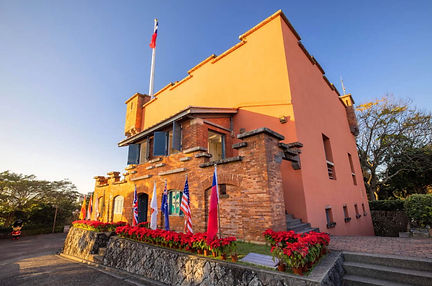
Fort San Domingo is over 300 years old and is easily Tamsui’s most iconic landmark. Back in 1629, the Spanish invaded Tamsui and built "Fort San Domingo" to strengthen their hold on northern Taiwan. Then in 1642, the Dutch kicked the Spanish out and rebuilt the fort on the same spot. Local Taiwanese back then called the Dutch "red-haired people" (Hongmao), which is how the fort got its local name—Hongmao Castle—that people still use today.Fast forward to 1867, the British rented the place, gave it a major facelift, and built the British Consulate right next door on the east side to serve as the consul’s residence. The consulate’s red brick archways and green glazed-bottle balustrades complement the fort perfectly.It wasn't until 1980 that Taiwan finally got the place back. Sitting high up with a view overlooking the Tamsui River, it used to be a key strategic spot. The sunset here, known as "Sunset at Fort San Domingo," has long been famous as one of Tamsui’s eight best sights. It’s truly a spot where rich history meets stunning views!Once you're done exploring, if you’ve got some time to spare, grab a seat at one of the cozy cafés or garden restaurants right across the street. Located just above the riverfront park, it's the perfect spot to kick back, sip on a coffee, or enjoy some fresh seafood while taking in the beautiful view of the Tamsui River estuary and Mount Guanyin right in front of you. It's honestly such a treat!

The Little White House
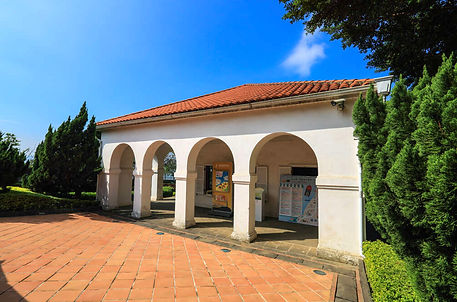
The Residence of Tamsui Customs Commissioner, also known as the "Little White House," was built in 1862 and has a history of well over a hundred years. It gets its famous nickname from its eye-catching, Spanish-style all-white exterior. Located in an area formerly known as "Paotaipu," it sits at the highest point of the second hill up from the mouth of the Tamsui River. When Tamsui opened its port for foreign trade back in the 1860s, this area became the main hub for foreigners doing business, trading, and living here. They built a lot of exotic, western-style buildings around that time, and the Little White House—a classic colonial-style building—was one of them. Colonial-style architecture comes with a few signature features, like a raised foundation, French doors and windows, chimneys, and wide wrap-around porches called verandahs. Locals back then had a habit of naming western buildings by their color. Since both the inside and outside of this residence were painted completely white, locals affectionately dubbed it the "Little White House." When you visit, you definitely can't miss the neatly lined-up arches. When the sun shines down on them, the white building looks even crisp, clean, and elegant. This simple yet stylish Spanish white-plaster arch corridor is a huge hit with photographers, and it’s one of the top choices in town for wedding photoshoots! From the viewing platform in the garden, you can get a beautiful bird’s-eye view of the Tamsui River. Inside, you’ll find exhibits on the mansion's history along with old photos of Tamsui’s past. With its clean white walls, bright orange roof popping against the blue sky, and romantic arched walkways, the place just naturally radiates a super romantic vibe.

Hobe Fort
Built back in 1886, Hwei-Wei Fort was spearheaded by Taiwan's very first governor, Liu Ming-chuan. In its heyday, it was a major military stronghold guarding Tamsui Port. Even though the original cannons are gone today, you can still sense just how important this place was a century ago from its outer walls and the remaining cannon mounts. It was officially named a national historic site in 1985. Sitting high up with its rock-solid construction, this impressive fort is a fantastic example of 19th-century military defense and coastal fortification. After the Sino-French War, the Qing court wanted to beef up Taiwan’s coastal defenses, so they decided to build ten forts across five key ports: Penghu, Keelung, Tamsui, Anping in Tainan, and Qihou in Kaohsiung. In 1886, Governor Liu Ming-chuan brought in Max E. Bause, a German engineer, to oversee the construction of these ten Western-style forts—and Hwei-Wei Fort was one of them. Perched on the highest point of the first hill of Tamsui’s "Five Tiger Hills," it used to give you a clear, wide-open view stretching all the way to the Tamsui River mouth and Guandu Bridge.

